Buy bilder-hosting.eu ?
We are moving the project
bilder-hosting.eu .
Are you interested in purchasing the domain
bilder-hosting.eu ?
domain@kv-gmbh.de · 0541-91531010
Buy bilder-hosting.eu ?
What is faster, SN1 or SN2?
SN2 reactions are generally faster than SN1 reactions. This is because SN2 reactions involve a single step where the nucleophile attacks the substrate at the same time the leaving group leaves, leading to a concerted mechanism. In contrast, SN1 reactions proceed through a two-step mechanism involving the formation of a carbocation intermediate, which can be a slower step. Additionally, the rate of SN2 reactions is dependent on the concentration of both the substrate and the nucleophile, while the rate of SN1 reactions is only dependent on the concentration of the substrate. **
Is an SN1 and E1 reaction favored here?
Yes, an SN1 and E1 reaction would be favored in this scenario. The presence of a tertiary alkyl halide suggests that the reaction will proceed through an SN1 or E1 mechanism due to the stability of the carbocation intermediate that forms. Additionally, the solvent being used is likely polar protic, which is favorable for SN1 and E1 reactions. Overall, the conditions provided are conducive to favoring an SN1 or E1 reaction. **

Similar search terms for SN1
Top-Angebote
Products related to SN1:
-
Lenox Hosting The Holidays Bread TrayWhether presenting an assortment of rolls or a buttery log of Texas toast, this festive ceramic Hosting the Holidays Bread Tray will not disappoint. The tray features a holly motif and is accented with 24-karat gold.44,49 $*Shipping: 0,00 $Secure redirect to the provider
-
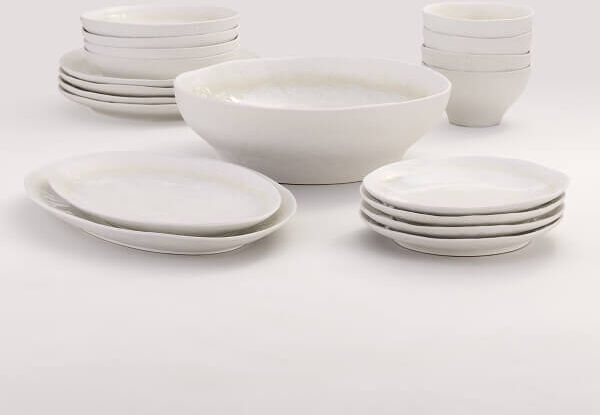
Stellar Stoneware Bantham Hosting For 4 SetIntroduce calm, contemporary style to your table with the Stellar Stoneware Bantham collection. Defined by smooth, modern contours and a soft green reactive glaze, each piece brings a fresh, artisan-inspired feel to everyday dining. Crafted from durable stoneware and fired for exceptional strength, the range offers excellent resistance to chipping and everyday wear. The naturally smooth glazed finish resists staining, cleans with ease, and provides a reassuringly balanced feel in hand. Its thick stoneware construction also enhances heat retention, helping dishes stay warmer for longer. Designed for modern living, every piece is microwave, dishwasher, and oven safe (up to 180°C), making the collection as practical as it is elegant—ideal for both daily use and relaxed entertaining. Set includes: 4 dinner plates, 4 side plates, 4x pasta bowls, 4 cereal bowls, 1x medium platter, 1x large platter and 1x serving bowl.199,95 £*Shipping: 0,00 £Secure redirect to the provider
-
Stellar Stoneware Bantham Hosting For 8 SetIntroduce calm, contemporary style to your table with the Stellar Stoneware Bantham collection. Defined by smooth, modern contours and a soft green reactive glaze, each piece brings a fresh, artisan-inspired feel to everyday dining. Crafted from durable stoneware and fired for exceptional strength, the range offers excellent resistance to chipping and everyday wear. The naturally smooth glazed finish resists staining, cleans with ease, and provides a reassuringly balanced feel in hand. Its thick stoneware construction also enhances heat retention, helping dishes stay warmer for longer. Designed for modern living, every piece is microwave, dishwasher, and oven safe (up to 180°C), making the collection as practical as it is elegant—ideal for both daily use and relaxed entertaining. Set includes: 8 dinner plates, 8 side plates, 8x pasta bowls, 8 cereal bowls, 1x medium platter, 1x large platter and 1x serving bowl324,95 £*Shipping: 0,00 £Secure redirect to the provider
-
Stellar Stoneware Mylor Hosting For 4 SetElevate everyday dining with the Stellar Stoneware Mylor collection, defined by its rich reactive glaze that gives each piece a subtly unique character. Blending warmth with understated style, Mylor brings a considered, artisanal touch to both casual meals and relaxed entertaining. Crafted from durable stoneware and fired for strength, each piece is designed to withstand daily use while maintaining its refined appearance. Plates and bowls are thoughtfully weighted for a balanced, comfortable feel in hand—offering reassuring sturdiness without compromising elegance. The thick stoneware construction also provides excellent heat retention, helping dishes stay warmer for longer. Designed for modern living, the collection is microwave and dishwasher safe, and suitable for oven use up to 180°C—ideal for everything from reheating to finishing dishes. Set includes: 4 dinner plates, 4 side plates, 4x pasta bowls, 4 cereal bowls, 1x medium platter, 1x large platter and 1x serving bowl.199,95 £*Shipping: 0,00 £Secure redirect to the provider


-
What factors lead to an SN1, E1SN2, or E2 mechanism?
The factors that lead to an SN1, E1, SN2, or E2 mechanism include the nature of the substrate, the strength of the nucleophile/base, the solvent, and the reaction conditions. For SN1 and E1 mechanisms, a polar protic solvent and a tertiary substrate favor the formation of a carbocation intermediate, while a strong nucleophile/base and a polar aprotic solvent favor SN2 and E2 mechanisms. Additionally, the leaving group ability of the substrate and the steric hindrance around the reaction center also play a significant role in determining the mechanism. **
-
Which reaction, SN1 or SN2, occurs in secondary halogen cycloalkanes?
In secondary halogen cycloalkanes, the SN1 reaction is more likely to occur. This is because the SN1 reaction involves a two-step process where the leaving group leaves first, forming a carbocation intermediate, and then the nucleophile attacks. The stability of the carbocation intermediate is important, and in secondary halogen cycloalkanes, the carbocation intermediate is more stable due to the presence of the neighboring alkyl groups. This makes the SN1 reaction more favorable in secondary halogen cycloalkanes compared to the SN2 reaction. **
-
Which type of nucleophilic substitution is known as SN1 or SN2?
The type of nucleophilic substitution known as SN1 or SN2 is SN1 (Substitution Nucleophilic Unimolecular) and SN2 (Substitution Nucleophilic Bimolecular). SN1 reactions proceed through a two-step mechanism involving the formation of a carbocation intermediate, while SN2 reactions occur in a single step with simultaneous bond formation and bond breaking. The choice between SN1 and SN2 mechanisms depends on factors such as the nature of the substrate, nucleophile, and solvent. **
-
What does kersign sn1 1 mean? I know that it has to do with all permutations with even sign, but what does kersign sn1 1 mean?
Kersign sn1 1 refers to the Kervaire sign of the permutation sn1 1. The Kervaire sign is a concept in algebraic topology that is used to study the homotopy groups of spheres. In this context, sn1 1 represents a specific permutation, and kersign sn1 1 refers to the sign of this permutation in the context of algebraic topology. The Kervaire sign is related to the study of the stable homotopy groups of spheres and has applications in the classification of exotic spheres. **

What is the question about the SN1 and SN2 reactions in chemistry?
The question about SN1 and SN2 reactions in chemistry typically revolves around the differences between these two types of nucleophilic substitution reactions. Students may be asked to compare the reaction mechanisms, the role of the solvent, the stereochemistry of the products, and the factors that influence the reaction rate. Additionally, they may be asked to predict the major products of a given reaction based on the reaction conditions and the nature of the substrate. **
According to which mechanism do the two molecules react: SN1, SN2, E1, or E2?
The mechanism by which two molecules react depends on the specific reaction conditions and the nature of the reactants. If the reaction involves a nucleophile attacking a substrate and forming a carbocation intermediate, it is likely to proceed via an SN1 mechanism. On the other hand, if the reaction involves a nucleophile directly displacing a leaving group in a single step, it is more likely to proceed via an SN2 mechanism. E1 and E2 mechanisms involve the elimination of a leaving group to form a double bond, with E1 involving the formation of a carbocation intermediate and E2 occurring in a single step with the nucleophile acting as a base. **
Top-Angebote
Products related to SN1:
-
ESP LTD SN1-HT Black Blast 2021 Electric Guitar black - RefurbishedThis is an ESP LTD SN-1 HT Electric Guitar in Black Blast finish. Made in Korea in 2021, this guitar consists of a Swamp Ash body, a Roasted Maple neck, and a 22-fret Macassar Ebony fingerboard. Other appointments include a Hipshot Fixed String-Through-Body bridge, LTD Locking tuners, fingerboard scalloping from frets 17-22, and a Fishman Fluence Open Core Classic Humbucker in the bridge position. This pickup is wired to a master volume that has a push/pull voice selector function. The Roasted Maple neck plays very well, with the Thin 'U' neck shape being particularly comfortable and easy to manoeuvre. The satin finish applied to the neck makes for a slick playing feel underhand, a trait also shared by the Macassar Ebony fingerboard. Playing comfort is further aided by the 22 Jumbo frets making for both easy bends and minimal effort from the fretting hand, with the last 6 frets being scalloped. The Fishman Fluence Open Core Classic Humbucker gives you a pure and uncorrupted musical tone as it gets rid of the hum and unwanted noise that often comes along with other pickups alike. This pickup has a searing bite to it, perfect for metal riffing. There is plenty of clarity and definition to be teased out of it, even with the gain cranked to 11. The pickup cleans up nicely too, with shimmery sounds at the ready with subtler amp settings. The push/pull volume control allows you to switch between voice 1 and voice 2 of the pickup, allowing you to explore different tones regardless of the minimal controls.800,00 £*Shipping: 0,00 £Secure redirect to the provider
-
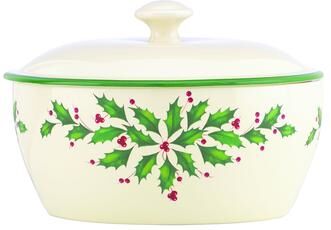
Lenox Hosting The Holidays Covered CasseroleThis Hosting the Holidays Casserole Dish is ideal for serving large dinner parties. Crafted of durable ivory porcelain, this spacious dish features a festive holly motif and comes with a matching lid.45,99 $*Shipping: 0,00 $Secure redirect to the provider
-
Lenox Hosting The Holidays Bread TrayWhether presenting an assortment of rolls or a buttery log of Texas toast, this festive ceramic Hosting the Holidays Bread Tray will not disappoint. The tray features a holly motif and is accented with 24-karat gold.44,49 $*Shipping: 0,00 $Secure redirect to the provider
-
Stellar Stoneware Bantham Hosting For 4 SetIntroduce calm, contemporary style to your table with the Stellar Stoneware Bantham collection. Defined by smooth, modern contours and a soft green reactive glaze, each piece brings a fresh, artisan-inspired feel to everyday dining. Crafted from durable stoneware and fired for exceptional strength, the range offers excellent resistance to chipping and everyday wear. The naturally smooth glazed finish resists staining, cleans with ease, and provides a reassuringly balanced feel in hand. Its thick stoneware construction also enhances heat retention, helping dishes stay warmer for longer. Designed for modern living, every piece is microwave, dishwasher, and oven safe (up to 180°C), making the collection as practical as it is elegant—ideal for both daily use and relaxed entertaining. Set includes: 4 dinner plates, 4 side plates, 4x pasta bowls, 4 cereal bowls, 1x medium platter, 1x large platter and 1x serving bowl.199,95 £*Shipping: 0,00 £Secure redirect to the provider
-
What is faster, SN1 or SN2?
SN2 reactions are generally faster than SN1 reactions. This is because SN2 reactions involve a single step where the nucleophile attacks the substrate at the same time the leaving group leaves, leading to a concerted mechanism. In contrast, SN1 reactions proceed through a two-step mechanism involving the formation of a carbocation intermediate, which can be a slower step. Additionally, the rate of SN2 reactions is dependent on the concentration of both the substrate and the nucleophile, while the rate of SN1 reactions is only dependent on the concentration of the substrate. **
-
Is an SN1 and E1 reaction favored here?
Yes, an SN1 and E1 reaction would be favored in this scenario. The presence of a tertiary alkyl halide suggests that the reaction will proceed through an SN1 or E1 mechanism due to the stability of the carbocation intermediate that forms. Additionally, the solvent being used is likely polar protic, which is favorable for SN1 and E1 reactions. Overall, the conditions provided are conducive to favoring an SN1 or E1 reaction. **
-
What factors lead to an SN1, E1SN2, or E2 mechanism?
The factors that lead to an SN1, E1, SN2, or E2 mechanism include the nature of the substrate, the strength of the nucleophile/base, the solvent, and the reaction conditions. For SN1 and E1 mechanisms, a polar protic solvent and a tertiary substrate favor the formation of a carbocation intermediate, while a strong nucleophile/base and a polar aprotic solvent favor SN2 and E2 mechanisms. Additionally, the leaving group ability of the substrate and the steric hindrance around the reaction center also play a significant role in determining the mechanism. **
-
Which reaction, SN1 or SN2, occurs in secondary halogen cycloalkanes?
In secondary halogen cycloalkanes, the SN1 reaction is more likely to occur. This is because the SN1 reaction involves a two-step process where the leaving group leaves first, forming a carbocation intermediate, and then the nucleophile attacks. The stability of the carbocation intermediate is important, and in secondary halogen cycloalkanes, the carbocation intermediate is more stable due to the presence of the neighboring alkyl groups. This makes the SN1 reaction more favorable in secondary halogen cycloalkanes compared to the SN2 reaction. **
Similar search terms for SN1
-
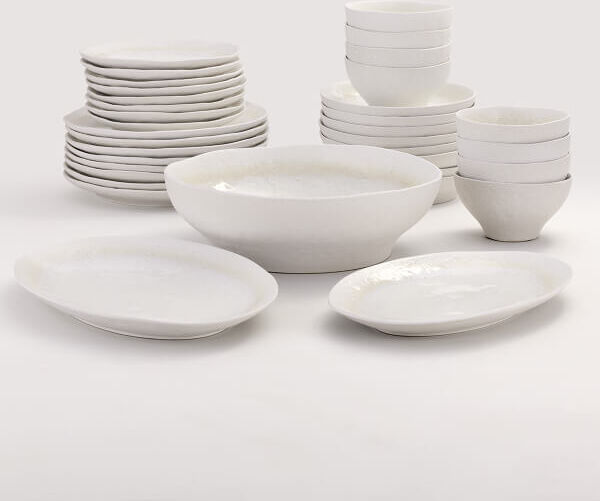
Stellar Stoneware Bantham Hosting For 8 SetIntroduce calm, contemporary style to your table with the Stellar Stoneware Bantham collection. Defined by smooth, modern contours and a soft green reactive glaze, each piece brings a fresh, artisan-inspired feel to everyday dining. Crafted from durable stoneware and fired for exceptional strength, the range offers excellent resistance to chipping and everyday wear. The naturally smooth glazed finish resists staining, cleans with ease, and provides a reassuringly balanced feel in hand. Its thick stoneware construction also enhances heat retention, helping dishes stay warmer for longer. Designed for modern living, every piece is microwave, dishwasher, and oven safe (up to 180°C), making the collection as practical as it is elegant—ideal for both daily use and relaxed entertaining. Set includes: 8 dinner plates, 8 side plates, 8x pasta bowls, 8 cereal bowls, 1x medium platter, 1x large platter and 1x serving bowl324,95 £*Shipping: 0,00 £Secure redirect to the provider
-
Stellar Stoneware Mylor Hosting For 4 SetElevate everyday dining with the Stellar Stoneware Mylor collection, defined by its rich reactive glaze that gives each piece a subtly unique character. Blending warmth with understated style, Mylor brings a considered, artisanal touch to both casual meals and relaxed entertaining. Crafted from durable stoneware and fired for strength, each piece is designed to withstand daily use while maintaining its refined appearance. Plates and bowls are thoughtfully weighted for a balanced, comfortable feel in hand—offering reassuring sturdiness without compromising elegance. The thick stoneware construction also provides excellent heat retention, helping dishes stay warmer for longer. Designed for modern living, the collection is microwave and dishwasher safe, and suitable for oven use up to 180°C—ideal for everything from reheating to finishing dishes. Set includes: 4 dinner plates, 4 side plates, 4x pasta bowls, 4 cereal bowls, 1x medium platter, 1x large platter and 1x serving bowl.199,95 £*Shipping: 0,00 £Secure redirect to the provider
-
Stellar Stoneware Mylor Hosting For 8 SetElevate everyday dining with the Stellar Stoneware Mylor collection, defined by its rich reactive glaze that gives each piece a subtly unique character. Blending warmth with understated style, Mylor brings a considered, artisanal touch to both casual meals and relaxed entertaining. Crafted from durable stoneware and fired for strength, each piece is designed to withstand daily use while maintaining its refined appearance. Plates and bowls are thoughtfully weighted for a balanced, comfortable feel in hand—offering reassuring sturdiness without compromising elegance. The thick stoneware construction also provides excellent heat retention, helping dishes stay warmer for longer. Designed for modern living, the collection is microwave and dishwasher safe, and suitable for oven use up to 180°C—ideal for everything from reheating to finishing dishes. Set includes: 8 dinner plates, 8 side plates, 8x pasta bowls, 8 cereal bowls, 1x medium platter, 1x large platter and 1x serving bowl324,95 £*Shipping: 0,00 £Secure redirect to the provider
-
Scholastic Share Black Stories: Picture Book ProfilesThese three stories are tales of hope, courage, and inspiration.This set includes:Bessie the Motorcycle QueenI Am Ruby BridgesJust Like Jesse Owens Share Black Stories: Picture Book Profiles47,57 $*Shipping: 0,00 $Secure redirect to the provider
-
Which type of nucleophilic substitution is known as SN1 or SN2?
The type of nucleophilic substitution known as SN1 or SN2 is SN1 (Substitution Nucleophilic Unimolecular) and SN2 (Substitution Nucleophilic Bimolecular). SN1 reactions proceed through a two-step mechanism involving the formation of a carbocation intermediate, while SN2 reactions occur in a single step with simultaneous bond formation and bond breaking. The choice between SN1 and SN2 mechanisms depends on factors such as the nature of the substrate, nucleophile, and solvent. **
-
What does kersign sn1 1 mean? I know that it has to do with all permutations with even sign, but what does kersign sn1 1 mean?
Kersign sn1 1 refers to the Kervaire sign of the permutation sn1 1. The Kervaire sign is a concept in algebraic topology that is used to study the homotopy groups of spheres. In this context, sn1 1 represents a specific permutation, and kersign sn1 1 refers to the sign of this permutation in the context of algebraic topology. The Kervaire sign is related to the study of the stable homotopy groups of spheres and has applications in the classification of exotic spheres. **
-
What is the question about the SN1 and SN2 reactions in chemistry?
The question about SN1 and SN2 reactions in chemistry typically revolves around the differences between these two types of nucleophilic substitution reactions. Students may be asked to compare the reaction mechanisms, the role of the solvent, the stereochemistry of the products, and the factors that influence the reaction rate. Additionally, they may be asked to predict the major products of a given reaction based on the reaction conditions and the nature of the substrate. **
-
According to which mechanism do the two molecules react: SN1, SN2, E1, or E2?
The mechanism by which two molecules react depends on the specific reaction conditions and the nature of the reactants. If the reaction involves a nucleophile attacking a substrate and forming a carbocation intermediate, it is likely to proceed via an SN1 mechanism. On the other hand, if the reaction involves a nucleophile directly displacing a leaving group in a single step, it is more likely to proceed via an SN2 mechanism. E1 and E2 mechanisms involve the elimination of a leaving group to form a double bond, with E1 involving the formation of a carbocation intermediate and E2 occurring in a single step with the nucleophile acting as a base. **
* All prices are inclusive of VAT and, if applicable, plus shipping costs. The offer information is based on the details provided by the respective shop and is updated through automated processes. Real-time updates do not occur, so deviations can occur in individual cases. ** Note: Parts of this content were created by AI.